
Reclaiming Narratives to Combat Erasure
7th Annual NWREC keynote speaker explores storytelling as the key to finding community and sense of belonging
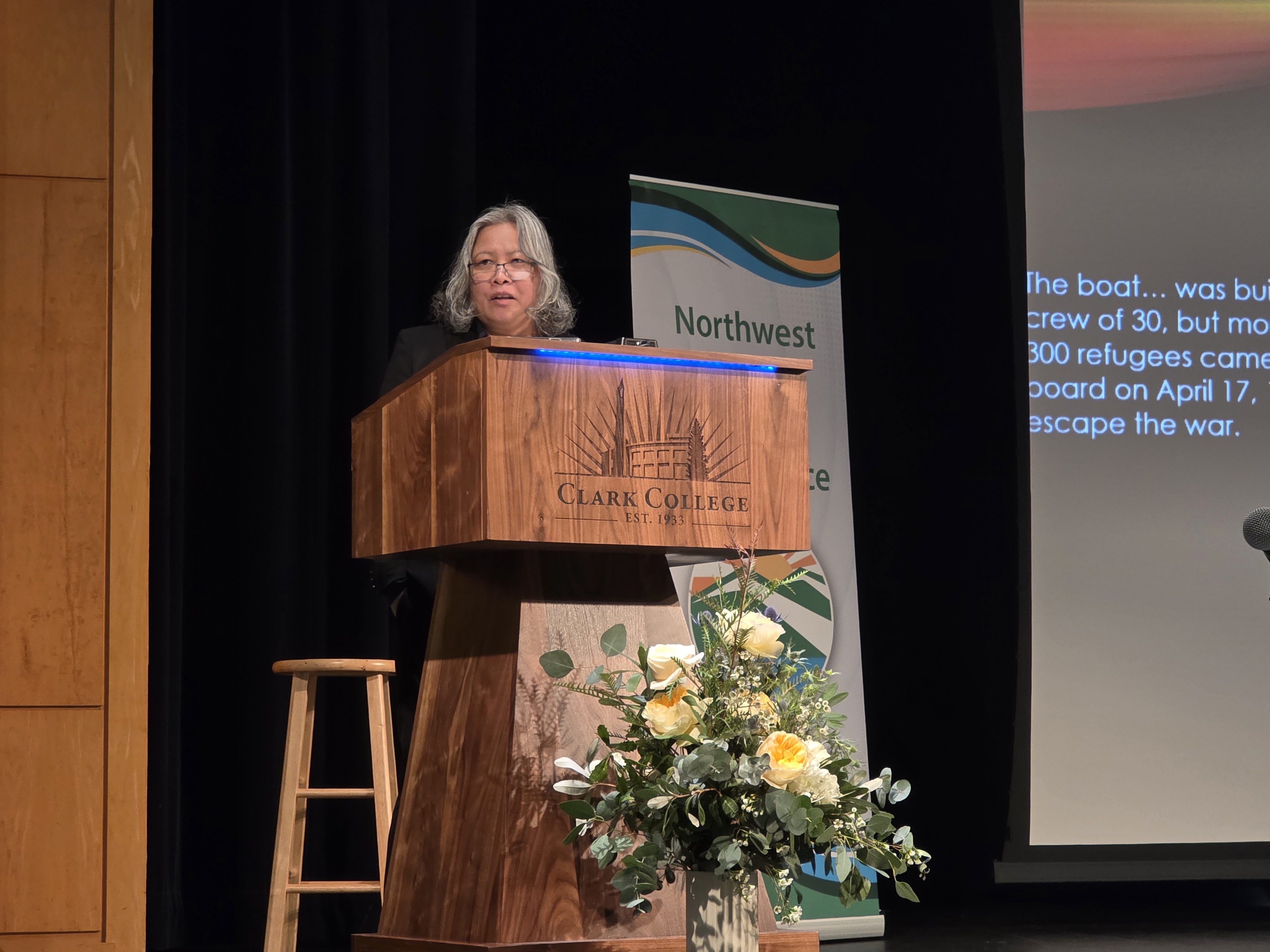
On Feb. 11, Clark College hosted the 7th annual Northwest Regional Equity Conference, bringing together educators, leaders, students, organizers, nonprofit professionals, and equity advocates from across the region. This year’s theme, “Reclaiming Our Narratives,” invited participants to explore how to regain and reshape narratives that define our communities, institutions, and identities.
The date carried added weight. The event coincided with the one-year anniversary of the prefiling of House Bill 1959, legislation seeking to eliminate the state's Office of Equity. For keynote speaker Putsata Reang, this timing underscored the urgency of her message.
Why Stories Matter
In Putsata’s address, “Reclaiming Our Stories to Combat Erasure," she wove together personal history and national headlines to highlight that storytelling is an act of resistance.
She pointed to the renaming of places such as the Alaskan mountain Denali — changed to honor a president who had never set foot in Alaska — as an example of how language and identity can be stripped from communities. These words, which represent a sense of place, are being rapidly replaced.
“Telling our stories is the key piece to pushing back on how our stories are being erased,” she said.
Putsata proudly described herself as a storyteller. She began her career as a journalist, telling other people’s stories, before becoming a memoirist. Over time, she came to understand the power her own story could hold.
While teaching a 9th-grade memoir-writing class, she asked students to write down the good and difficult experiences they faced over the past year. As they shared, patterns emerged. Themes of death, rebirth, and identity surfaced again and again, showing that while our stories may be personal, they make us part of the collective.
She emphasized this with something her mother would often say: “One chopstick is easy to break. But a handful of chopsticks is unbreakable.”
However, that sense of belonging is often undermined by inequity. From the NFL, where most players are Black, yet team ownership and coaching remain overwhelmingly white, to the removal of Black Lives Matter murals and inclusive language in public spaces, she pointed out that stories are being erased in real time.
Reclaiming the Narrative
Putsata then carried the audience across continents and generations.
During the Khmer Rouge genocide, which killed nearly 2 million Cambodians in the late 1970s, Putsata’s family fled the country when civil war reached their idyllic coastal town, leaving behind what her mother described as a “life of abundance.” With little warning, they boarded a boat built to carry only 30 people—it held 300.
For months, passengers endured cramped quarters, hunger, and dehydration. During this journey, her mother cradled her infant child, who grew weaker by the day until, eventually, the baby appeared lifeless. The boat’s captain urged the grieving mother to throw the body overboard for the sake of the health of the others on board. She refused. For 23 weeks, she held the child, adamant that she would bury her baby on land. When they finally reached shore, she brought her baby to a hospital, where she discovered the baby was still alive.
“That baby,” Putsata said, pausing, “was me.”
Hearing that story as a young person shaped her understanding of survival and obligation. What else could she do, she asked herself, but keep her mother happy and try to be worthy of this rescue?
But by carrying her mother’s story, she began to lose her own.
Growing up in Corvallis, Oregon, in a traditional Cambodian household, Putsata described trying to physically erase the brown from her skin in a classroom of mostly white students, and not fully understanding the feelings she had for the girl next door. At home, she and her sister — “but not my brother,” she noted — were expected to learn to cook so their future husbands would come home to a hot meal. A life without a husband was unthinkable.
Those expectations were powerful and overwhelming, creating waves of shame over Putsata as others dictated who she was supposed to be.
But, she said, “It’s just a story.” She realized she didn’t have to be that person, so she reclaimed her own story and eventually turned it into her memoir.
“The pain has to go somewhere,” she said. “Might as well put it on the page.”
Reclaiming her own story did not mean discarding her mother’s. It meant honoring the sacrifices that saved her life while also claiming space for her own identity.
As she closed her address, Putsata encouraged audience members to share their own stories.
“Because I survived this journey...I can be with you today. My story means more alongside yours. We are connected by an invisible web of humanity. It’s time to tell our stories.”
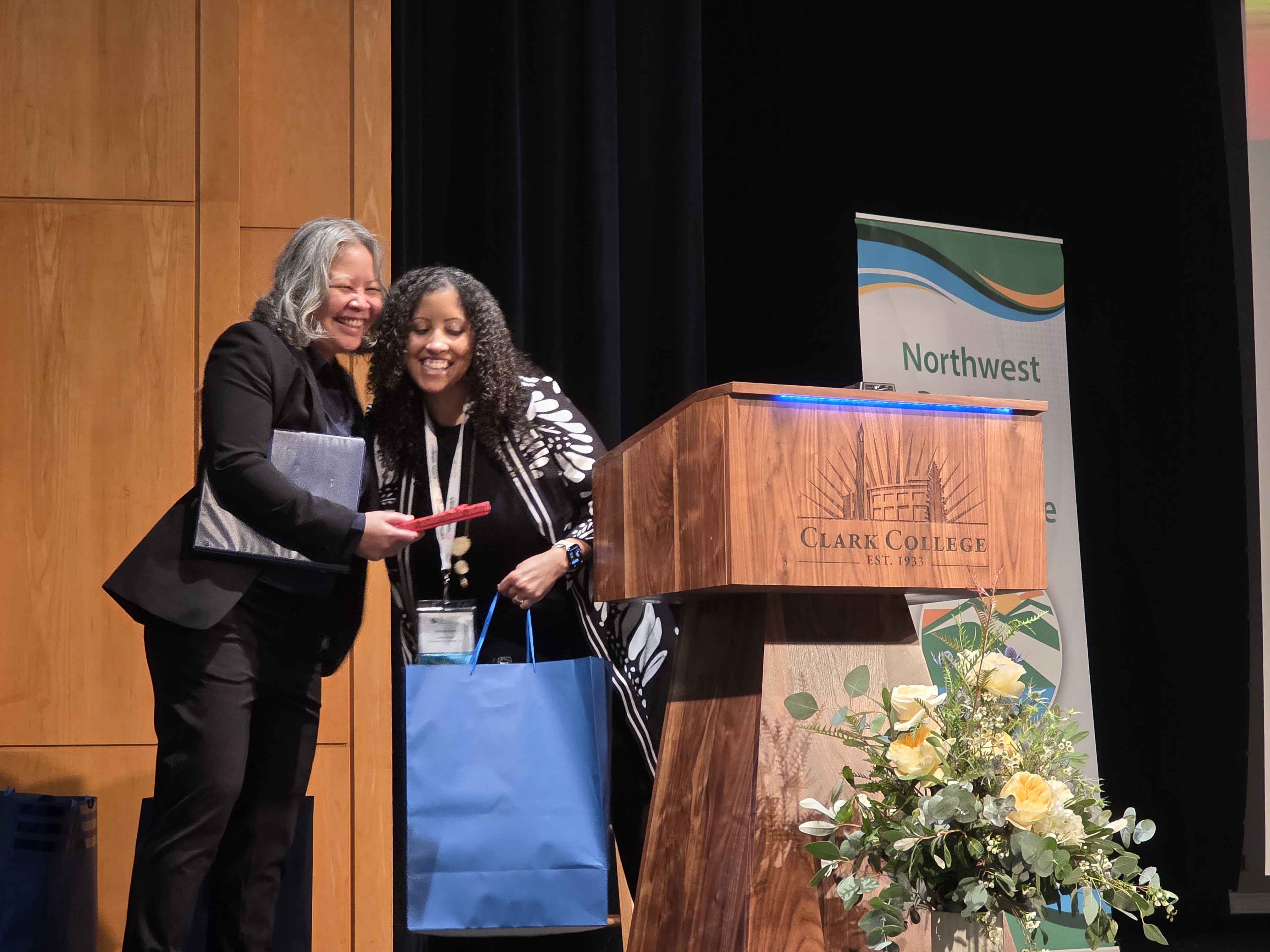
Pictured: Vanessa Neal (right) presented Putsata Reang with a feather necklace, "for liberation."
About Putsata Reang
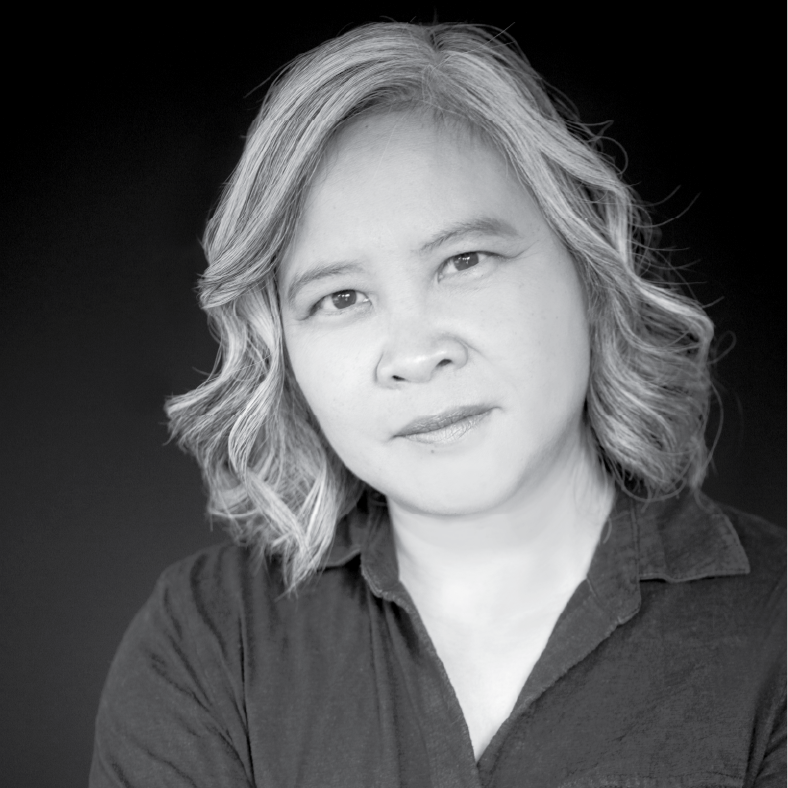 Putsata Reang is an award-winning author and journalist whose work has appeared in publications
including The New York Times, Politico, The Guardian, Ms., The Seattle Times, and The San Jose Mercury News. Her debut memoir, Ma and Me (FSG/MCD, 2022), won the Pacific Northwest Booksellers Association Prize for Nonfiction
and was a finalist for the Dayton Literary Peace Prize and the Lambda Literary Prize.
Born in Cambodia and raised in rural Oregon, Putsata explores themes of displacement,
family, and identity, including the experiences of children of refugees and the challenges
of growing up LGBTQ+.
Putsata Reang is an award-winning author and journalist whose work has appeared in publications
including The New York Times, Politico, The Guardian, Ms., The Seattle Times, and The San Jose Mercury News. Her debut memoir, Ma and Me (FSG/MCD, 2022), won the Pacific Northwest Booksellers Association Prize for Nonfiction
and was a finalist for the Dayton Literary Peace Prize and the Lambda Literary Prize.
Born in Cambodia and raised in rural Oregon, Putsata explores themes of displacement,
family, and identity, including the experiences of children of refugees and the challenges
of growing up LGBTQ+.
Putsata has lived and worked in more than a dozen countries and is a 2019 Jack Straw Fellow. Her journalism has been recognized with an Alicia Patterson Fellowship, and she is an alumna of Hedgebrook, Mineral School, and Kimmel Harding Nelson residencies. Putsata teaches memoir writing in schools and is a sought-after speaker at colleges, conferences, and organizations, including Microsoft and the State Fund of California. She has been featured on NPR’s On Point and Dani Shapiro’s Family Secrets podcast.
Learn more about Putsata Reang and her memoir, Ma and Me.
About NWREC
The Northwest Regional Equity Conference (NWREC) is an annual gathering that brings together educators, students, leaders, and community partners from across the Pacific Northwest to advance equity, inclusion, and belonging in education and beyond. Hosted by Clark College, NWREC creates space for dialogue, learning, and action focused on improving equitable and sustainable experiences and outcomes for systemically marginalized and underrepresented populations. Through workshops, keynote speakers, and collaborative sessions, the conference fosters connection, shared learning, and meaningful change.
Featured photo: Clark College/Malena Goerl
Story by Malena Goerl, Staff Writer, Communications and Marketing